UT Austin’s response to racist attacks against Asian students criticized
Automatically translated from Spanish. Read the original in Spanish
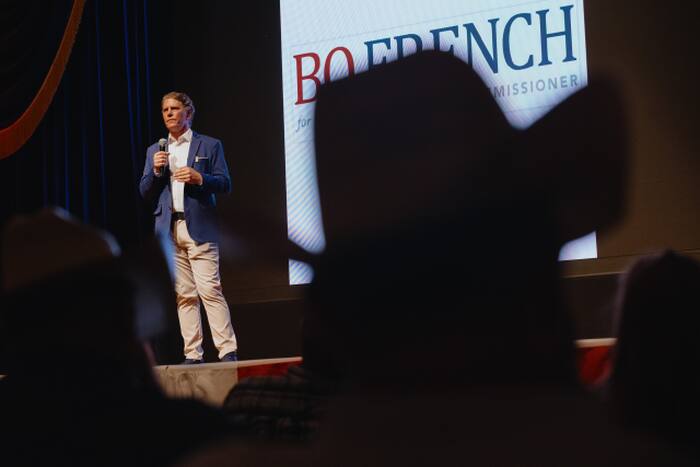
A student of Indian descent, who has lived in California his entire life, experienced deep fear when moving to Texas to pursue a doctorate in economics at the University of Texas at Austin. However, during the Longhorns’ exciting victory over Ohio State in September, this student shared the experience with international peers, teaching them about American football and celebrating the win. The student later wrote that, while sweating with three minutes left in the fourth quarter, he knew the university would be a part of him forever. However, that joy turned to despair and shock the next morning when Bo French, the Republican candidate for Texas Railroad Commissioner, posted a photograph on the social network X of South Asian students celebrating the victory, suggesting that their presence on campus was a problem.
Following the outcry on the internet over French’s message, UT-Austin President Jim Davis took 35 hours to issue a response, in which he stated that all students at the institution were Longhorns, but avoided directly mentioning French’s comments. This lukewarm response prompted the doctoral student to send an email to the president expressing his discontent. In his message, the student questioned whether Davis truly believed his words were sufficient and requested that he name French, denounce his racism, affirm that Indian-Americans are also Americans, and record a video looking into the camera to assure them that they belong at the university.
Documents obtained by The Texas Tribune reveal that this student, whose name was redacted along with those of other current students, was not the only one to express disappointment with the stance of university leaders. These records offer insight into the dilemma public university presidents face regarding political disputes that affect their campuses: determining whether it is enough to express general support or if it is necessary to explicitly condemn those responsible for the attacks. On September 12, one day after the Longhorns’ victory, Bo French posted the image of the students at 7:52 a.m., claiming that the problem was much worse than anyone could have imagined.
As criticism against French mounted that Sunday, university officials monitored the situation and handled requests for comment. That same afternoon, Patrick Wiseman, vice president of marketing and communications at UT-Austin, informed his colleagues via a Microsoft Teams message that he was keeping university leadership updated. Wiseman noted that French was being heavily criticized by other sectors and that it was not necessary for the university to stoop to participating in that politics or issue an official comment. However, students and alumni pressured leaders to speak out. A UT law student acknowledged that the university should avoid getting involved in political matters, but urged Davis to reassure students of Indian descent, warning that the silence was becoming too loud.
The next morning, UT-Austin spokesperson Mike Rosen told reporters that the university had no plans to issue a statement. At the same time, communications officials attempted to influence media coverage regarding the international student population. Katie Boshart, director of reputation management and affairs, contacted outlets such as The New York Times and USA TODAY to request that they emphasize that international students represented approximately 4% of undergraduate students, rather than nearly 10% of the total student population, including graduates. Boshart argued that this distinction was relevant because the controversy centered on undergraduate admissions, although both figures were accurate according to the population measured.
By Monday afternoon, pressure on Davis continued from parents, students, and alumni. The president’s office had received at least 22 emails regarding French’s comments. Rohan Reddy Gupta, a 2020 graduate, wrote that silence in the face of intolerance amounted to complicity and that a clear, public condemnation of the racist comments was not optional, but a moral obligation. That same evening, at 6:02 p.m., the chairman of the UT System Board of Regents, Kevin Eltife, publicly expressed his support for the students. Eltife wrote on X that, upon seeing the stands of DKR-Texas Memorial Stadium filled with fans, he saw Longhorns and was proud to celebrate all students that day and always.
At 6:46 p.m., Davis shared Eltife’s statement, adding that he was proud to stand with Chairman Eltife and reiterating that all students are Longhorns. Despite this, neither Davis nor Eltife mentioned French by name or labeled his comments as racist. Emails to Davis’s office continued, totaling more than a dozen additional messages. Nicolas Cocavessis, a 1978 UT graduate, urged the president to directly condemn French, mentioning his son and four friends, all children of immigrants born in the United States, who graduated from UT and developed successful careers in finance, oil, computing, and law. Cocavessis asked Davis to do the right thing.
Criticism persisted throughout the following week. Greg Rives, a 1998 graduate, wrote to Davis on September 25, lamenting that he had not called on Bo French to offer a public apology, noting that had he done so, the student body would have seen a president they could trust, but that instead, Davis had failed. Historically, previous UT-Austin presidents had been more direct in the face of attacks on students. In 2017, then-president Gregory Fenves condemned flyers that attacked students of Chinese and Asian descent, calling them unacceptable and stating that everyone had the right to study without fear of discrimination. On that occasion, authorities removed the flyers and opened an investigation.
Since then, the UT System Board of Regents adopted an institutional neutrality policy that could have limited officials’ response to the French case. However, it is unclear if this policy influenced the decision, as neither Davis nor Eltife responded to requests for comment, and UT System officials did not respond to questions from the Tribune. In August 2024, months after pro-Palestinian protests resulted in more than 100 arrests at UT-Austin, the Board of Regents adopted a policy stating that university officials should not express positions on current events in their official capacity, no matter how appealing they may be to some sectors.
This policy seeks to allow students and faculty to debate controversial topics without feeling pressure to adopt the institutional stance. Brian Soucek, a law professor at the University of California, Davis, and author of the book “The Opinionated University,” noted that such policies usually include exceptions to defend the university’s core mission, such as educating students regardless of their race or background. Soucek questioned why the UT System policy did not explicitly include such an exception. For its part, UT-Austin’s internal guidelines allow for official statements in exceptional cases where an event has a unique impact on the university community or public safety.
Soucek opined that French’s comments met UT-Austin’s exception criteria, as they directly attacked students. The expert warned that universities are increasingly using institutional neutrality to avoid defending their own values, calling UT’s response an example of cowardice in a situation where speaking out would have had positive effects on the perception of inclusion. Brian Rosenberg, who was president of Macalester College in Minnesota for 17 years, agreed that presidents must reassure students attacked by racism, although he showed some understanding of Davis’s difficult position. Rosenberg explained that public university presidents face political pressures that leaders of private institutions do not, as they depend on state legislators for their funding and face risks if their decisions anger elected officials.
On October 16, Davis addressed offensive speech more broadly following an incident on campus where conservative podcaster Myron Gaines used racist and sexist slurs. Students criticized the handling of the event and demanded stricter enforcement of rules against harassment and discriminatory conduct. Davis wrote that he could not remove the pain of experiencing offensive comments, but urged students not to stop to listen or engage with those seeking to provoke them, emphasizing that outsiders do not define the university.
Despite the institutional stance, three UT-Austin professors — Keshav Pingali, Vijay Chidambaram, and Chandrajit Bajaj — took steps to reassure students after the incident. In an email, they expressed their support for all students regardless of their ethnicity and offered to help those who needed to talk. Pingali explained that the growing hostility toward Indian-Americans motivated the message and acknowledged that some students feared attending future football games. Eli Friedman, a freshman in computer science who received the email, expressed mixed feelings, valuing the professors’ gesture but questioning why the university itself had not taken a similar initiative.
Reporting from KPRC Click2Houston
Written by Latinos en Texas based on reporting published by KPRC Click2Houston.
See the original story (opens in a new tab)
Source: KPRC Click2Houston