No, Illinois voting machines do not show which candidates are less popular
Automatically translated from Spanish. Read the original in Spanish
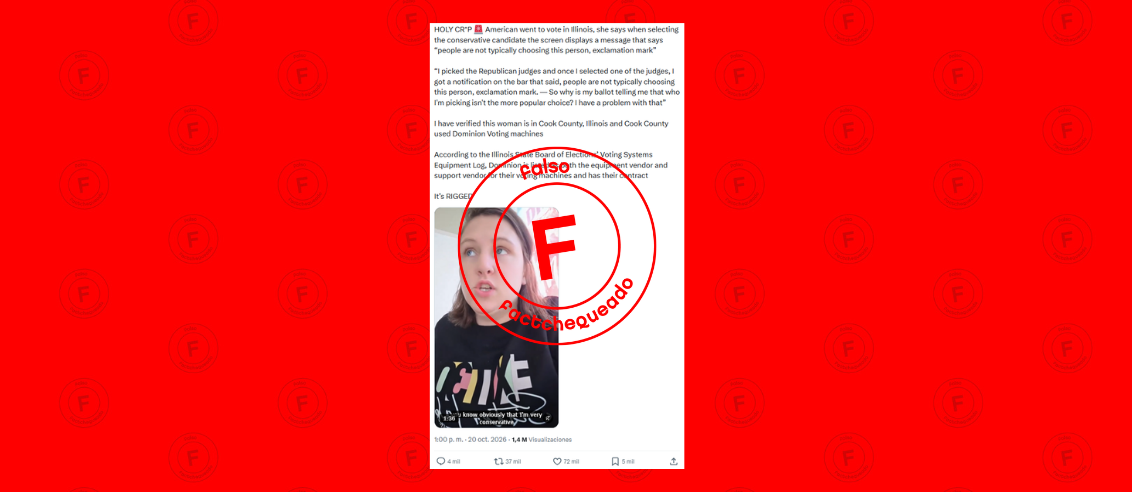
A post is circulating claiming that an American woman went to vote in Illinois and that, upon selecting a conservative candidate, the screen displayed a message saying: “People usually do not choose this person.” Based on this alleged incident, the posts claim that the November 3, 2026, midterm elections are “rigged.” However, it is false that voting machines in Illinois indicate that a candidate is unpopular.
Election authorities deny that voting machines indicate the popularity of candidates. Furthermore, the woman initially claimed she had received the alert when voting for Republican judicial candidates, even though the ballot in Cook County, the most populous in Illinois, did not include Republican candidates in judicial races.
Election authorities deny that machines indicate the popularity of candidates
In the video, the woman explains that she voted for Republican judges and that, upon selecting one of them, a notification appeared saying: “People usually do not choose this person.” “Why is my ballot telling me that the person I am choosing is not the most popular option? I have a problem with that,” she states.
Frank Herrera, director of communications for the Cook County Clerk’s Office, stated to the AFP agency that “the claims circulating in this video are manifestly false and mislead the public about how voting equipment actually works in the suburbs of Cook County.”
As he explained, voting machines “do not tell voters which candidates are more popular nor do they discourage them from selecting any particular candidate.”
Cook County Clerk Monica Gordon also debunked the claim in a Facebook post. “A video circulating on social media contains false and misleading claims about the voting equipment used in the suburbs of Cook County,” she noted.
Voting machines can show warnings if voters leave a race blank
Gordon explained that the machine “can display a notification if a voter leaves an election race blank or does not make all available selections.” Something known as undervoting.
This feature allows voters to check their selections and confirm that they reflect their intentions before casting their vote. Gordon emphasized that voters can freely choose the candidates they prefer or leave any election race blank.
The Cook County ballot did not include Republican judicial candidates
The woman in the video said she lives in Streamwood and voted early in Cook County. Although she claimed to have chosen Republican judges, at Factchequeado we verified that there are no Republican judicial candidates on the ballot. Something that was also confirmed by Sally Daly, deputy clerk of communications for the Cook County Clerk’s Office, to PolitiFact, a partner of Factchequeado.
Subsequently, the woman published a video in which she rectified her initial version and clarified that the message had appeared when voting for commissioners of the Metropolitan Water Reclamation District, and not for judges. However, she maintained her claim that the machine showed a notification that, according to her, indicated her selection was less popular.
For his part, Aris Garcia, municipal clerk of Streamwood and member of the Republican Party, stated that they tried to reproduce the described message, but could not recreate the reported experience.
“It is also important to clarify that there are no Republican judicial candidates on the Cook County ballot for the November 3, 2026, elections. Therefore, the claim that the woman selected a Republican judicial candidate does not match the ballot,” Garcia indicated.
Factchequeado is a fact-checking media outlet that builds a Spanish-speaking community to counter disinformation in the United States. Do you want to be part of it? Join us and verify the content you receive by sending it to our WhatsApp +16468736087 or to factchequeado.com/whatsapp.
Read also:
No, voting machines selecting a different candidate does not mean the midterm elections are “rigged”
Originally published by Factchequeado
Republished in full and unchanged under the Creative Commons BY-SA 3.0 license. It was first published by Factchequeado.
See the original story (opens in a new tab)
Source: Factchequeado